The Object and the Event
Excerpt from Chapter 5 of Research Methods for Creating and Curating Data in the Digital Humanities (Edinburgh University Press, 2016)
Jonathan Monaghan began creating artwork using 3D digital animation software in 2007, while still an undergraduate student training for a technical career in the entertainment industry. After finishing his degree he made the unusual choice to apply his technical skills to a career as a fine-artist rather than following his peers into the industry. He has gone on to create an extensive body of video artwork using the sophisticated simulation techniques developed by the movie and video-game industries. He is an artist who grew up in the world of digital simulation as first a consumer and then a creator of content. In an email conversation, Monaghan states: ‘My first artistic interests were not traditional painters, sculptors, or even video artists, but video game designers and science fiction movies’. Although games and movies were what first inspired Monaghan, he has taken the techniques and visual language of these commercial forms and re-purposed them to very different ends. His work deals with the history of power structures within our society, but it does not take the familiar form of ‘institutional critique’ artworks. His videos are gorgeous and kitsch extravaganzas of architecture and materialism. They seem to revel in their own excess whilst simultaneously creating a pervasive air of the uncanny. In this world a giant mutant penguin consumes its own young while merged with the architecture of a gothic cathedral. We watch the decadent relics of France’s ancien regime explode in disco-hued slow motion in the dead zone of a generic capitalist cubicle farm.
In an excerpt from a recent article Monaghan describes his work:
Orchestrated in a virtual computer space, my works act more as windows into another world, another dimension, a kind of alternate reality. This world is fantastical and bizarre, but parallels our own, where imagery of power, wealth, and authority are conflated with consumerism, science fiction, ancient mythologies, and historical works of art.
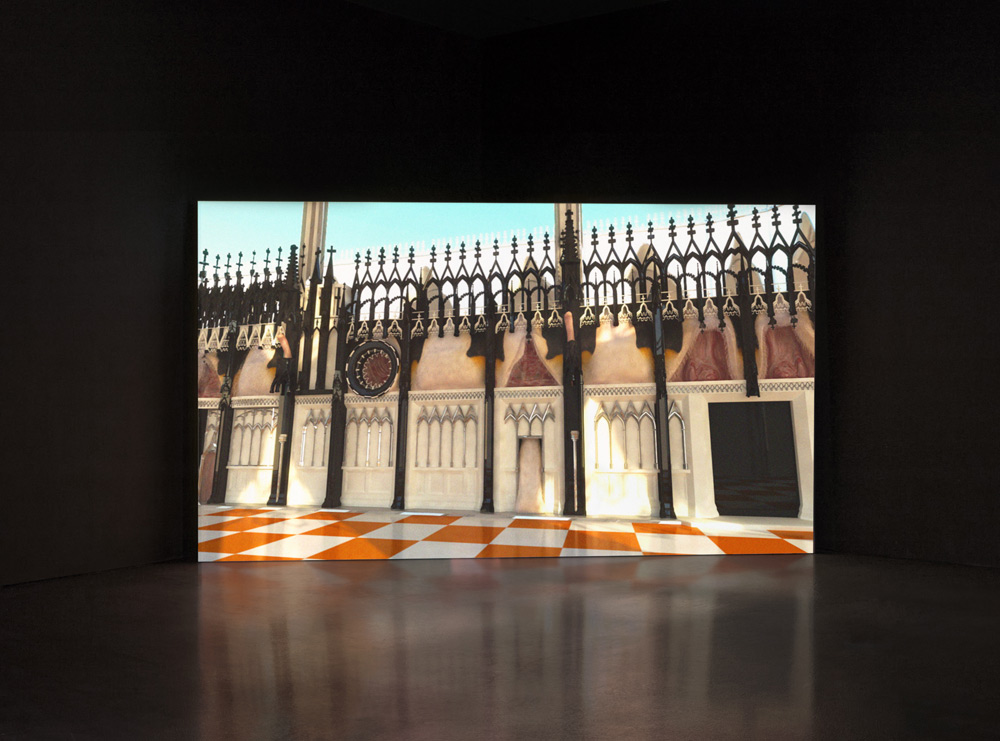
The above mentioned penguin appears in 2009’s French Penguin. Over the course of the video the camera moves through a gothic cathedral which has lost its roof. There are a number of queasily biological elements integrated into the architecture which breathe and flex. The camera moves along the ambulatory before turning the corner into the apse to reveal an altarpiece that has been hybridized with a giant emperor penguin. Rather than guarding an egg between its feet, the penguin gives birth to a monstrous flesh-blob child with a black cross growing out of its head. The penguin parent promptly eats its young and returns to its original somnolent state.
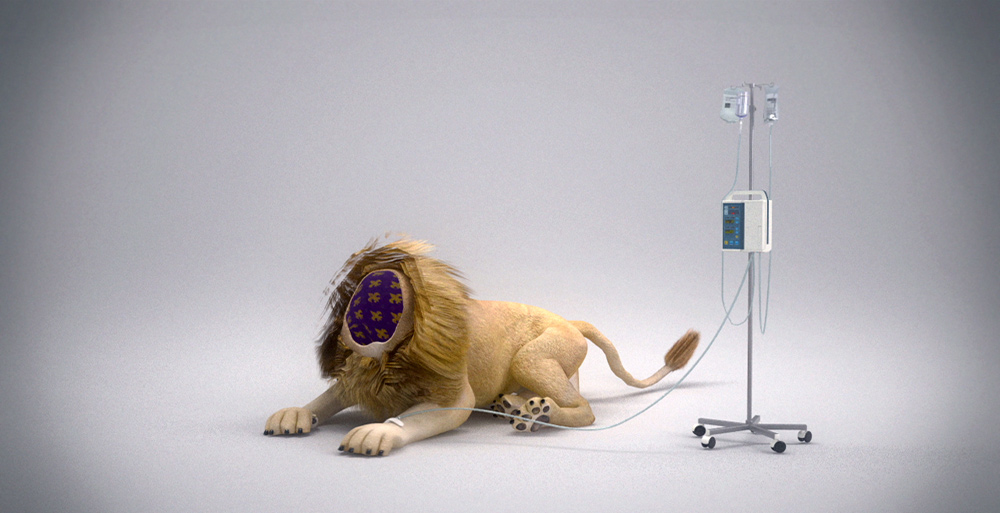
Jonathan Monaghan’s interest in the history of power and privilege has led him to borrow imagery for French Penguin from the later days of the French monarchy, and the revolution that deposed it. He refers to these quotations as evocations of ‘tragic or perilous decadence’. The piece Dauphin 007 (2011), is another good example of this, combining the story of the prince, as personified by a lion, with hi-tech medical equipment (another recurring theme). The young prince/cub is born, along with his crown, from a highly detailed gothic façade which once again incorporates a number of biological elements. Before he can assume his crown it is stolen by a black eagle. The crown is hovering overhead once more when the lion prince walks into a glossy plastic MRI scanner which is also a guillotine. His head is removed and flies away leaving his hollow and headless body hooked up to an IV drip. The black eagle returns to torment him before we see him expire in a white heaven, dwarfed by a maniacal rotating chandelier of medical equipment.
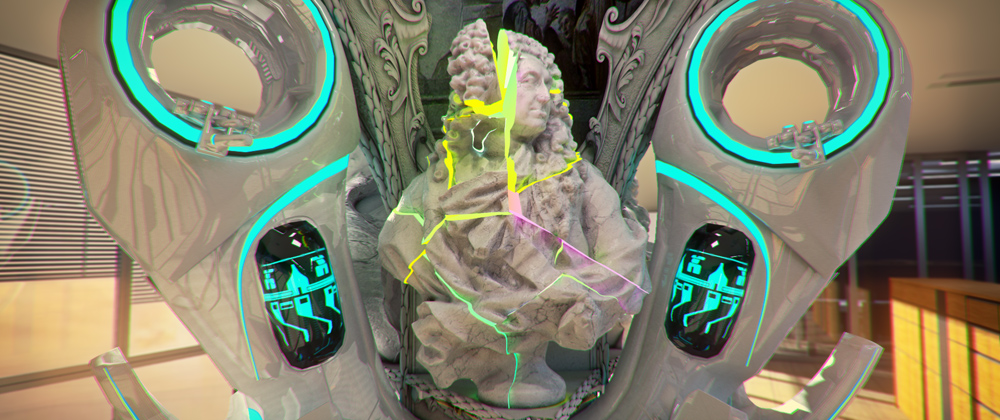
The associations between historical power structures and those of the present day are brought to mind by Office (2013), which focuses on a mysterious object in a familiar office environment. It appears to consist of a fragment of baroque architectural ornament complete with painted vignettes and marble busts of the rich and powerful of eighteenth century France. As the camera rotates around the object we see a series of shiny plastic structures alternating with the antique statuary. These seem to be modeled on the MRI scanner which first appeared in Dauphin 007, but they also have a sci-fi feel as they include cryptic control panels and glowing pin-stripes. As the camera continues to orbit the mysterious object the statues of the great men of another age explode slowly into a myriad of fragments, revealing interiors that glow with vibrant pastel colours.
Monaghan’s strategy, as stated above, is to create a ‘parallel world’ in order to explore the real world. Digital simulation allows him to choreograph objects which do not belong together into impossible events. The processes of history are made visible by the collision of objects and environments from different times, a metaphor for the constant conversation between the past and the present that goes on within any culture. The 3D digital environment allows him to create facsimiles of hybrid luxury objects with such a high level of finish and precision that they become parodies of our timeless obsession with bling. It is all here, from the excesses of Baroque architecture to the expensive materials and stripped down lines of high modernist interiors, from the Fabergé Egg to the glossy and opaque surfaces of the latest Apple device. This kind of software allows the artist to create anything she can imagine, in fact her imagination is the only limit. In Monaghan’s case this allows him to create constant confusion between the organic and the inorganic, between the living and the dead. An air of the uncanny prevails as architecture sprouts fleshy appendages and orifices or a galloping stag is rendered in highly polished gold. Monaghan’s animals sprout buildings and his buildings give birth to animals. The work is replete with the kind of ‘riddle without solution’ mentioned above, drawing the viewer into a conversation with the imagery without ever offering an answer. The power of these effects depends on the realism of the individual parts in contrast to the absurdity of the situations they find themselves in, something only made possible by the digital environment that Monaghan chooses to work in.
Stephen Hilyard is an artist and Professor of Digital Arts at the University of Wisconsin Madison.