The Information Fold
Excerpt from Chapter 4 of The Fold: From Your Body to the Cosmos (Duke University Press, 2024).
Aesthetics would seem a poor tool to analyze the power relations blackboxed by the information-image, especially as many of their effects are precognitive. This is why we need to study not the perceptible side of the interface but the interface itself and the programs, applications, data sets, and infrastructure that support it. Yet another arrow in the informationimage analyst’s quiver is affective analysis, as I suggest in Chapter 5: researching affective responses to information-images. Interestingly, interfaces produce affective responses even, or especially, when the perceptible image is slim. Recipients feel their effects, Fuller and Goffey note: “delight, terror, geeky enthusiasm, mildly hypnotic euphoria, ugly feelings, and paranoid rage”; general unease. These responses are useful data for critical analysis.
What we are apprehending, they write, are “the dimly sensed links between affective configurations and the broader, unstable networks of agents and mediators of which we are a part, with their difficult-to-perceive boundaries and their correlative scope for producing troubling uncertainties.” Put differently, we are feeling the disquiet of belonging to a soul-assemblage that we didn’t seek membership in—a most likely toxic soul-assemblage of corporate extraction and surveillance. Affective analysis triangulates between what can be perceived at affectively intense moments and the interface that generated those perceptibles and affects. The analyst gets a sense of what produced that euphoria or discomfort. Those sensations are the differentials between the world that information unfolds to us and the infinite beyond.
The smooth surfaces of computer-generated animation often express the airlessness of an infoworld closed in on itself. Jonathan Monaghan’s sleek and darkly humorous animations, bristling with branded commodities and steeped in end-of-days symbolism, evoke the mythically vacuum-sealed world of information capitalism. Crafted from calculations, with their smooth surfaces and fractal levels of detail, his images generate a digital sublime more complete and perfect than any personal hallucination. Monaghan’s worlds resemble the closed cosmology of Leibniz in which each monad is a microcosm of the whole; their mises-en-scène undulate with Baroque folded architectures.
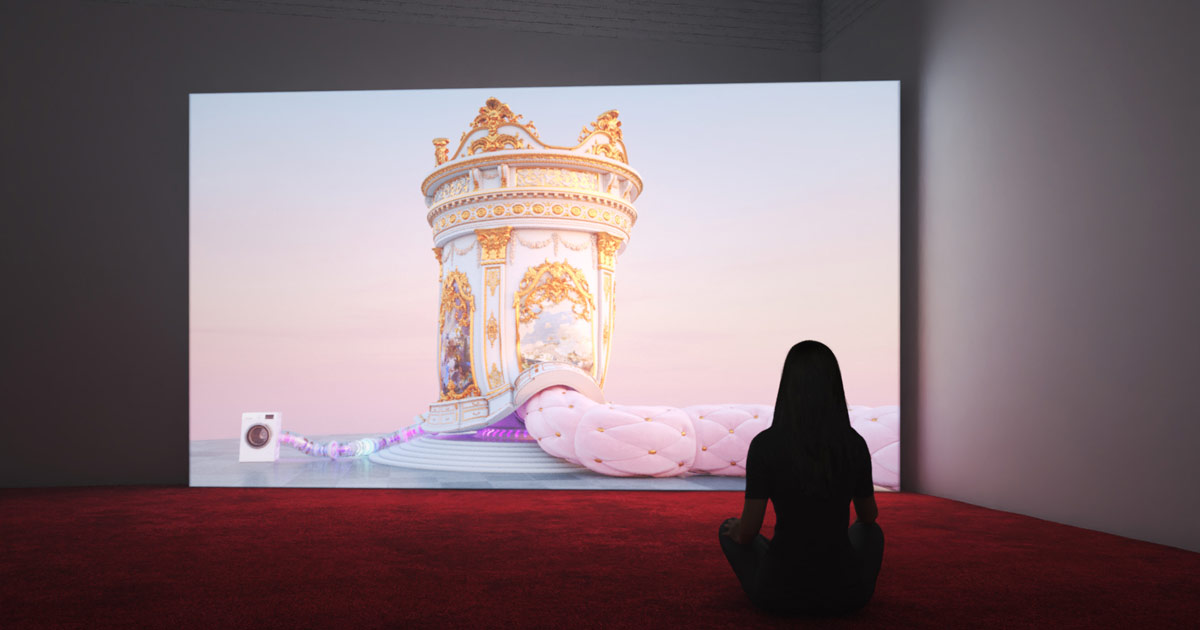
Designed for exhibition in galleries, they loop, ouroboroslike, reinforcing the sense that there is no outside to the commodity universe. In Monaghan’s Den of Wolves (US, 2020) three robotic wolves in gilded, modem-equipped armor prowl a deserted Washington, DC, in search of raiment for a monarch, an imminent Beast. In a single simulated shot the animation glides through the closed world, up and up through ocular openings, from a vast Walmart-like basement to a Whole Foods-type storefront to the Apple store now inhabiting the ground floor of the Capitol Building, red rental scooters abandoned outside, and up through the building’s white and gilded dome interior. The wolves’ destination is a dimension-defying space capsule, a rococo microcosm of the governmental architecture, that lifts into the heavens. Through a tufted, gold-buttoned pink velvet umbilicus (Chanel?) that reaches from the capsule’s ground floor to its top floor (hello, Leibniz!), something is pumping— resources stolen from the abandoned Earth, perhaps. Along translucent cables glowing lights travel in the opposite direction, as though transforming material into information. As the shot travels into the heart of this extractive knowledge center, the big reveal—the noumenon of it all—is a boutique coffee shop. Zooming smoothly past the La Marzocco espresso machine, the shot glides into the small refrigerator, between boxes of water (“Boxed Water Is Better”) and surveillance cameras, tilts down—and we find ourselves in the deserted Walmart once again. Den of Wolves brilliantly deploys the loop format to create a sense that information capitalism’s theft of analog life is inevitable, cyclical, and irresistibly seductive.
In the seamless world generated by and for digital technology there appear to be no organic beings, but an eerie organicism pervades, what Perniola calls the “sex-appeal of the inorganic.” Yet, as in many of Monaghan’s works, there is one hint of organic being in Den of Wolves. The Beast that rumbles to its feet in the Walmart is a creased mass of red velvet, its armor gilt-trimmed dehumidifiers, its protruding eyes surveillance cameras; but when it roars, the interior of its mouth and its stippled tongue are flesh. It’s as though the constitutive materiality that is repressed everywhere else in this closed cosmos lurks in the fleshy interior folds of the devouring monster.
Laura U. Marks is a philosopher and scholar of new media and film. She is the Grant Strate University Professor at Simon Fraser University. Previously, she was the Dana Wosk University Professor of Art and Cultural Studies at SFU.