Gotham
From self-published exhibition catalog for Gotham, Jonathan’s 2016 solo exhibition at Galerie 22,48m² in Paris
“Cities, like dreams, are made of desires and fears, even if the thread of their discourse is secret, their rules are absurd, their perspectives deceitful, and everything conceals something else.” Italo Calvino, Invisible Cities
Jonathan Monaghan questions our perception of cities and immerses us into varying dimensions of reality. Through prints, sculpture, and video works, the artist constructs seemingly urban landscapes that come to life through movement, robotics, and 3D animation. Jonathan’s distinct aesthetic, informed by gaming, science fiction, Baroque architecture, and the luxury goods industry, creates a cohesive and recognizable style throughout his oeuvre. His work offers us a window into another world parallel to our own, and where elements of our everyday have been cut up and pasted back together into something new.
Conjuring a mythical city in his newest body of work titled Gotham, Jonathan tells the story of a dystopian future informed by urban architecture. By using video game graphics, the artist creates a virtual space we are free to explore like the avatars inside a game. There are never any humans or even part-human characters in Monaghan’s world. As a result, each viewer becomes the protagonist of this unsettling and all too familiar world. As we go through the objects and environments that make up Gotham, we encounter a world of high-end hotel receptions, gold and crystal chandeliers, white leather embossed with diamonds, and luxury building showrooms. Through his complex and highly detailed constructions, Monaghan has imagined a future mythology of the present world concerned with wealth and power.
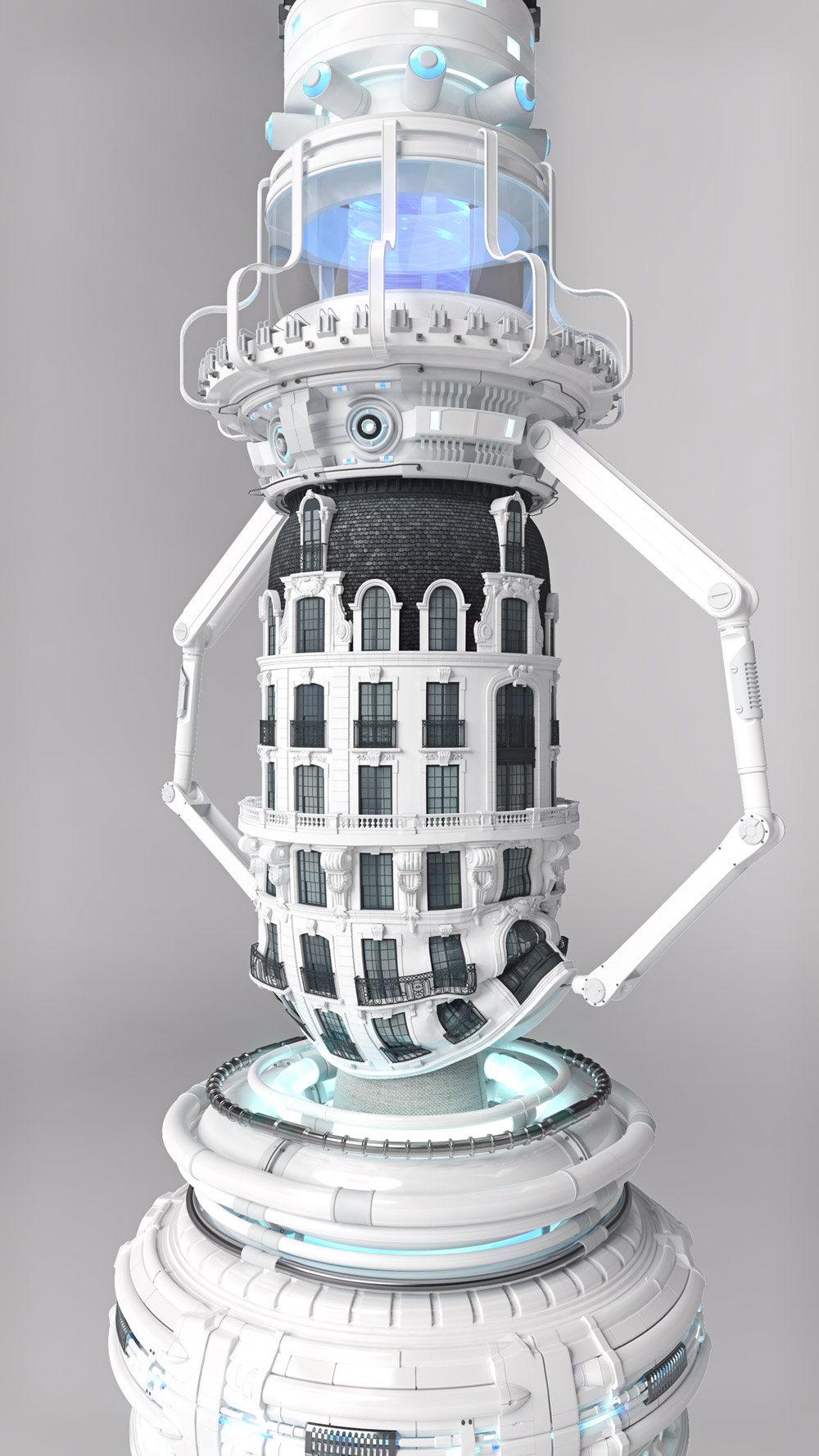
The video piece Scroll humanizes a robotic character constructed from various architectural elements. The body we are initially confronted with recalls the late 19th century apartment buildings found on the Upper West Side of Manhattan. Engaged in thorough research on the architectural history of wealthy New York developments, Monaghan has recreated a detail construction of familiar buildings in the digital realm. Here it is The Prasada building at 50 Central Park West, whose surface has been recreated in the most minute detail. As the hypothetical camera slowly pans up on the object, we understand that this said building is merely a part of a much more sophisticated living being or biosphere. Robotic surgeon hands lift up the building’s surface, which we immediately see as functioning like a shirt or cloth that covers its body. Underneath this layer where we expect to see the construction beams that hold up the facade is instead another kind of skeleton. A skin-like beige fabric, which contrasts with the sleek white plastic and metal used on the outside of the work, exposes a belly button: the signifier for the body. By slowly revealing insides of fur, luxury fabrics, and futuristic devices, Monaghan engages in linguistic games with the viewer where signifiers and signified are divulged one after another.
Throughout his latest body of work, Monaghan plays with the viewer’s expectations of familiar architecture and the way it behaves in the world. What appears to be a building façade, constructed with bricks to maintain a vertical position, floats up in the air and ripples like a sheet in the wind. What seems to be a wealthy New York residence functions as a white curtain undulating over a black mirror. The world of Gotham remains an illusion and, as avatars of this game, we seek to question it. Layers of meaning peel off one by one like the skin of an orange to challenge the viewer’s understanding of their own perceptions over and over again. Monaghan has successfully transported us into his own world of imaginary cities where technology and the body have become one.
Juliette Premmereur is a curator and art advisor. She holds a M.A. in Modern Art from Columbia University’s Critical and Curatorial Studies program.